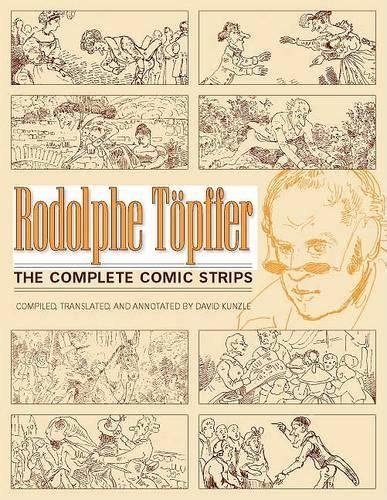
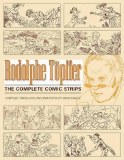
Rodolphe Topffer Comic Strips HC
$64.99
Writer: David Kunzle
Artist: David Kunzle
Publisher: University of Mississippi Pres
The "histories en estampes" (picture stories) published from 1833 to 1845 by Swiss writer and educator Topffer are important precursors to the modern graphic novel; a pirated edition of one of them, published in New York in 1842 as "The Adventures of Obadiah Oldbuck", is often regarded as the first American comic book. This volume is the first complete collection of Topffer's comics works, ably translated and annotated by Kunzle ("History of the Comic Strip: The Nineteenth Century"). Originally intended to amuse himself and his students and told in lively illustrations and narrative captions without dialog (and hence without word balloons), Topffer's stories are primarily freewheeling farces spiced with fantasy elements, formal invention, and social and political satire. They involve caricatured heroes such as social climber Monsieur Jabot and lepidopterist Monsieur Cryptogame in ever-escalating series of absurd adventures and complications. Kunzle provides historical and biographical context for the works in his simultaneously published companion volume, "Father of the Comic Strip: Rodolphe Topffer" (Univ. Pr. of Mississippi). While definitely more accessible, even riotous, than their remove from the present might suggest, Topffer's comics are unlikely to draw a large audience of modern comics fans. But this volume and its companion are essential for comics scholars.S.R. Copyright 2007 Library Journal, LLC Used with permission.
David Kunzle, professor emeritus of art history at the University of California, is author of Rebirth of the English Comic Strip: A Kaleidoscope, 1847-1870; Cham: The Best Comic Strips and Graphic Novelettes, 1839-1862; Father of the Comic Strip: Rodolphe Töpffer; and Gustave Doré Twelve Comic Strips, all published by University Press of Mississippi.
The recent legitimization of the comic strip has brought plenty of vintage-strip reprintings and analyses of the medium. David Kunzle offers volumes of both devoted to the nineteenth-century Swiss artist who may have invented the comic strip. Rodolphe Töpffer (1799-1846), whose work remains interesting also for the insight into its era that it affords, used many devices associated with comics, as the massive Rodolphe Töpffer: The Complete Comic Strips shows. Narratives consist of sequential arrays of cartoonish, simplified illustrations separated by panel borders. Töpffer didn't use word balloons, but each drawing is captioned. Pictures or words alone wouldn't suffice to tell the story--and that constitutes one very recognizable definition of comics. The eight stories in the book combine wild slapstick and droll social commentary as they relate the humorous exploits of such eccentrics as Mr. Jabot, who wreaks havoc at a society ball; Mr. Crepin, who oversees the education of his brood of unruly children; and Dr. Festus, who travels the world, leaving disaster in his wake.--Gordon Flagg "Booklist"









Share: